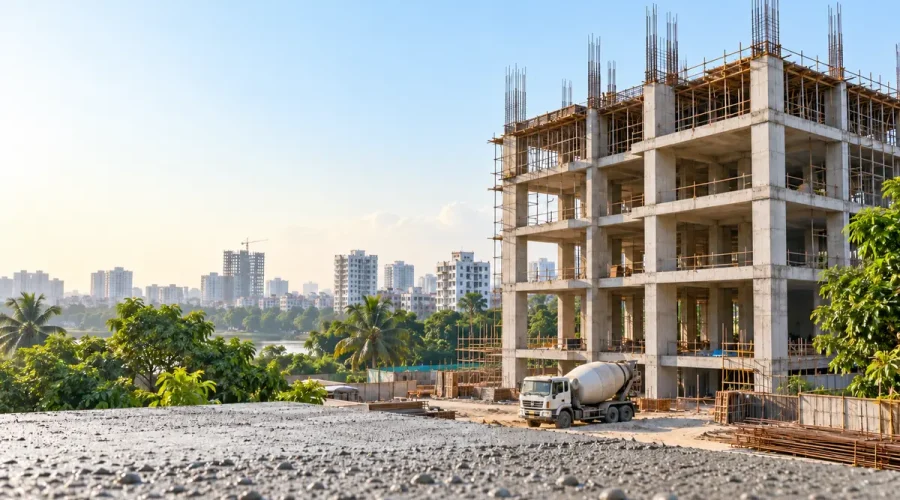
How Green Concrete Supports Sustainable Construction in Bangladesh
Green concrete supports sustainable construction in Bangladesh by reducing reliance on carbon-intensive cement clinker, using suitable recovered materials and limiting waste. When properly designed and tested, it can meet structural requirements while reducing environmental impact. Its benefits depend on material quality, production methods, transport and construction practices.
Bangladesh needs buildings and infrastructure that perform well for many years. For developers, engineers and property owners, this means considering both construction quality and the resources used to achieve it.
Green concrete offers a practical way to bring these goals together. From residential buildings to industrial facilities, it can help project teams reduce environmental impact while meeting the required strength and durability.
What Is Green Concrete?
Green concrete is concrete designed to have a lower environmental impact than a comparable conventional mix. In this context, “green” refers to environmental performance, not colour.
There is no single recipe. A mix may use lower-clinker cement, supplementary cementitious materials, suitable recycled aggregates or more efficient production methods.
However, adding a recycled ingredient does not automatically make concrete sustainable. The finished mix must perform as required, and environmental claims should be supported by data.
How Does Green Concrete Support Sustainable Construction?
1. Reduces the Carbon Footprint of Concrete
Clinker is a key ingredient in Portland cement. Reducing the amount needed for a concrete mix is an important route to cutting emissions.
Suitable supplementary cementitious materials can replace part of the Portland cement. Efficient structural and mix design can also help avoid unnecessary material use. The International Energy Agency identifies material efficiency and increased use of these materials as important measures for reducing cement and concrete emissions. Source: IEA
For projects in Bangladesh, the practical step is to compare mixes that meet the same performance requirements. A lower-carbon option should still deliver the specified strength, workability and service life.
2. Makes Better Use of Recovered Materials
Selected industrial by-products can become useful concrete ingredients. Examples include processed fly ash and ground granulated blast-furnace slag, often called GGBS.
Recycled concrete aggregate offers another opportunity. It is produced by crushing and processing suitable concrete waste and can replace some natural aggregate in approved applications.
However, recycled aggregate can differ in water absorption, cleanliness and consistency. Testing and mix adjustments are essential before use. Source: FHWA recycled concrete guidance
For Bangladesh, these options should be assessed against reliable supply, processing quality and transport distance. A recovered material is useful only when it meets the project’s requirements.
3. Can Improve Long-Term Durability
Sustainability also depends on how long a structure remains in service.
Properly selected supplementary cementitious materials can reduce permeability, making it harder for water and harmful substances to enter concrete. They can also support long-term strength development. Some mixes gain early strength more slowly, so curing and construction schedules need careful planning. Source: FHWA guidance on supplementary cementitious materials
For a project near saline water in coastal Bangladesh, the engineer should assess the actual exposure conditions. The mix, reinforcement protection, placement and curing must work together.
Green concrete is not automatically waterproof, corrosion-proof or suitable for every site. Its performance must match the intended use.
4. Encourages More Efficient Construction
A sustainable concrete plan should cover ordering, delivery and placement as well as ingredients.
Project teams can reduce avoidable waste by:
- Calculating concrete quantities carefully.
- Preparing formwork and access before delivery.
- Coordinating truck arrivals with the placement team.
- Controlling site handling and preventing rejected loads.
- Planning appropriate treatment or recovery of leftover materials.
For a busy urban site in Dhaka or Chattogram, delivery planning deserves particular attention. A well-designed mix still needs proper handling to achieve its intended performance.
5. Supports Better Environmental Reporting
Developers need evidence to compare materials and explain sustainability decisions.
An Environmental Product Declaration, or EPD, reports environmental impacts using life-cycle assessment data. A product-specific EPD can help buyers understand the impact associated with a particular concrete product. Source: NRMCA
An EPD is a disclosure document, not proof that a product is automatically the greenest choice. Comparisons need equivalent performance requirements and consistent assessment boundaries.
Green Concrete vs Conventional Concrete
Both options must satisfy the project’s engineering requirements. The main difference is the deliberate effort to reduce and document environmental impact.
| Factor | Conventional concrete | Green concrete approach |
|---|---|---|
| Binder selection | Meets the specified performance using the selected cement | Also considers lower-clinker options and suitable replacement materials |
| Aggregates | Commonly uses natural aggregates | May include tested recycled aggregates |
| Carbon impact | Depends on the actual mix and supply chain | Seeks a verified reduction against a comparable baseline |
| Strength | Must meet the project specification | Must meet the same required performance |
| Early strength | Depends on the mix and conditions | Some formulations may need more time |
| Cost | Depends on materials, delivery and placement | May be lower, similar or higher |
| Documentation | Usually focuses on quality and compliance | Also seeks evidence of environmental performance |
Where Can Green Concrete Be Used in Bangladesh?
Subject to engineering approval, suitable mixes may be considered for:
- Residential projects: foundations, columns, beams and slabs.
- Commercial buildings: offices, shopping centres and mixed-use developments.
- Industrial facilities: factories, warehouses and selected floor systems.
- Infrastructure: pavements, drainage structures and other specified works.
- Precast products: elements manufactured under controlled conditions.
The application determines the mix. For example, an industrial floor may need particular abrasion resistance, while a precast element may need early strength for handling.
One mix should not be assumed suitable for every application.
Is Ready Mix Concrete Automatically Green?
No. Ready mix describes how concrete is produced and supplied; it does not establish its environmental performance.
A ready mix supplier may offer lower-impact options through material selection, controlled batching and efficient operations. Buyers should still ask for the proposed mix details, performance results and evidence supporting carbon claims.
Similarly, concrete mixed on site should not be judged on the production location alone. The actual ingredients, quality control, waste and delivery arrangements matter.
How to Choose Green Concrete for Your Project
Use these five steps when discussing options with an engineer and supplier:
- Define the performance requirements. Confirm strength, exposure conditions, workability and the construction schedule.
- Review the proposed materials. Ask about the cement, replacement materials, aggregates and their sources.
- Check trial results. Confirm that the proposed mix achieves the required performance.
- Compare environmental evidence. Request a product-specific EPD or a clearly documented assessment where available.
- Plan delivery and curing. Make sure site practices support the approved mix.
Avoid choosing a product based only on claims such as “eco-friendly” or a stated percentage of recycled content.
Is Green Concrete Cost-Effective in Bangladesh?
Green concrete can be cost-effective, but it is not always cheaper per cubic metre.
The price depends on ingredient availability, processing, transport, testing and supplier capability. Any effect on construction speed also matters.
Compare the total project cost, including placement, curing, waste and expected maintenance. Potential long-term savings should be supported by the proposed design and performance evidence.
Frequently Asked Questions
What is the main benefit of green concrete?
Its main benefit is the potential to reduce environmental impact while meeting construction requirements. This may involve lower carbon emissions, reduced use of virgin materials or better resource efficiency.
Is green concrete as strong as conventional concrete?
It can meet the same specified strength when properly designed, produced and cured. Strength must be confirmed through testing, and early strength development can vary.
Which materials are used in green concrete?
Possible ingredients include lower-clinker cement, fly ash, GGBS and suitable recycled aggregates. The selection depends on quality, availability and the intended application.
Can green concrete be used in coastal Bangladesh?
Potentially, yes. The mix must be designed and tested for the site’s exposure conditions. The green label alone does not establish resistance to saline environments.
Does green concrete reduce construction time?
Not necessarily. Some mixes develop early strength more slowly. The engineer and supplier should coordinate mix selection with formwork removal, handling and loading requirements.
How much carbon can green concrete save?
There is no universal percentage. Savings depend on the mix, material sources, transport and assessment method. Any claim should identify the baseline and compare equivalent performance.
Building More Sustainably in Bangladesh
Green concrete can help Bangladesh build with greater care for resources and long-term performance. The strongest results come from combining an appropriate mix with verified materials, efficient delivery and proper construction practices.
For your next project, ask your engineer and concrete supplier to compare lower-impact options that meet the same structural and durability requirements. A sustainable choice starts with measurable performance.
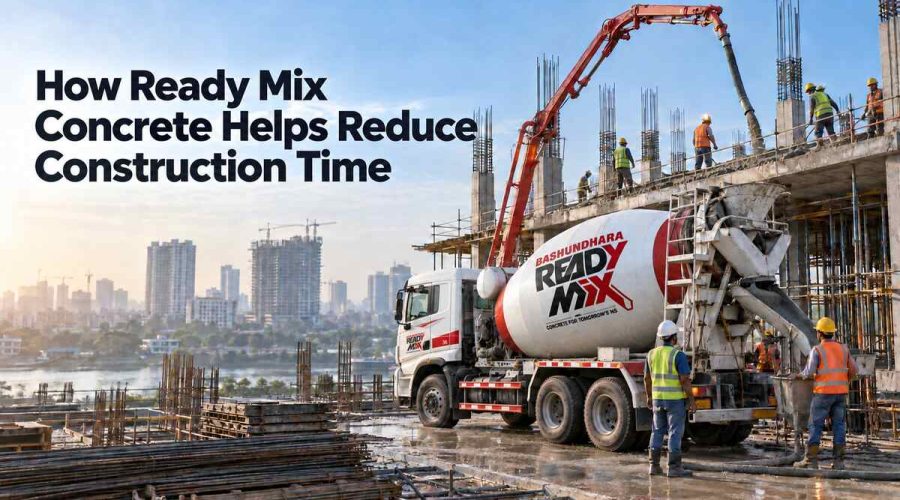
How Ready Mix Concrete Helps Reduce Construction Time
Ready mix concrete helps reduce construction time by removing the need to measure and mix concrete on-site. It is produced at a batching plant and delivered to the project ready for placement. This reduces preparation work, supports faster pouring and helps construction teams coordinate labour and equipment more efficiently.
For projects in Bangladesh, these benefits depend on planned deliveries, clear site access and a team ready to receive the concrete. Ready mix concrete can speed up preparation and placement, but it does not eliminate the curing time needed for concrete to develop strength.
That is where ready mix concrete changes everything. It has become one of the most important tools for fast construction concrete delivery across modern job sites. And in this blog, we will explain exactly how it works and why builders are choosing it more than ever.
What Is Ready Mix Concrete?
Ready mix concrete is concrete that is prepared at a central concrete batching plant and then delivered directly to the construction site in a fresh, usable state.
Instead of mixing cement, sand, aggregate, and water on-site, everything is done in a controlled factory setting. The right proportions are measured. The mixing is done precisely. Then the concrete travels in a rotating drum truck to reach your site ready to pour.
It sounds simple. But the impact on construction efficiency is massive.
Why Traditional On-Site Mixing Slows Things Down
To understand why ready mix is faster, it helps to look at how traditional concrete mixing works on a job site.
Workers have to manually measure each material. Mixing machines on-site are often smaller and less precise. Weather can affect the process. Human error creeps in. And all of this takes time the project cannot always afford.
On-site mixing also creates inconsistency. One batch may have too much water. Another may not have enough cement. These small mistakes weaken the structure and can lead to expensive rework.
Ready mix solves all of these problems before the concrete even leaves the plant.
How Ready Mix Concrete Speeds Up Construction
Here is where the real story begins. Rapid construction with ready mix is not just about speed, it is about removing every unnecessary step from the process.
1. No Mixing Time on Site
With ready mix, there is no time spent measuring or mixing at the location. The concrete arrives ready. Workers can start pouring immediately. This alone can save hours on a busy work day.
2. Quick Concrete Delivery on Demand
Modern ready mix suppliers operate with scheduled quick concrete delivery systems. You order the exact volume you need, and it arrives at a set time. This means no waiting, no downtime, and no wasted materials.
3. Consistent Quality Every Time
The concrete mix design at a batching plant follows strict standards. Every batch has the same strength grade, the same water-cement ratio, and the same workability. This consistency means fewer quality failures and less time spent on corrections.
4. Multiple Pours in One Day
Because delivery is fast and concrete is always ready, large sites can complete multiple pours in a single day. Work that used to take several days can now happen within hours.
5. Less Labour Required
On-site mixing needs a dedicated team just for concrete preparation. With ready mix, that team can be redirected to other parts of the build. Fewer people doing more work means the project moves forward faster.
Meeting Project Deadlines — The Bigger Picture
Construction delays are rarely caused by just one thing. But concrete problems are a surprisingly common culprit.
Bad weather slows outdoor mixing. Supply shortages affect raw materials. Worker shortages create gaps in the schedule. Every one of these issues hits harder when your concrete depends on what is available on-site that day.
Ready mix concrete removes most of these variables. The plant prepares everything in advance. The schedule is planned. The delivery is coordinated. And the construction team can focus on building, not on mixing.
For large commercial projects, infrastructure work, or high-rise buildings, sticking to project deadlines often depends on this kind of reliable, efficient supply chain.
Where Ready Mix Concrete Is Used in Modern Construction
Ready mix is used across almost every type of construction project. Here are some of the most common applications:
- Foundation slabs and footings
- Columns, beams, and structural frames
- Roads, bridges, and flyovers
- High-rise residential and commercial buildings
- Industrial floors and pavements
- Water treatment and drainage structures
Each of these applications benefits from consistent strength, faster pouring, and reliable scheduling, all things that modern construction demands.
Environmental and Waste Benefits
Speed is not the only advantage. Ready mix concrete is also more efficient in terms of material use.
On-site mixing often leads to over-ordering, spills, and leftover concrete that hardens and goes to waste. With ready mix, you order exactly what you need, no more, no less.
Batching plants also use dust control systems and recycle wash water. This makes ready mix a cleaner choice for urban construction where environmental regulations are stricter.
Bashundhara Ready-Mix: Trusted for Fast Construction
In Bangladesh, Bashundhara Ready-Mix has built a strong reputation for delivering consistent, high-quality concrete on time. Their batching plants follow international standards for mix design and quality control.
Whether the project is a high-rise building, a commercial complex, or a large infrastructure job, Bashundhara Ready-Mix ensures that fast construction concrete is always within reach. The focus is on reliability, so that builders can focus on what they do best.
With scheduled delivery, accurate volumes, and consistent grades, it is the kind of supply that helps a project stay on track from foundation to finish.
Things to Know Before Using Ready Mix Concrete
Ready mix is highly efficient, but it works best when you plan ahead. Here are a few things every builder should keep in mind:
• Order in advance: Ready mix plants need time to schedule and prepare. Last-minute orders can cause delays.
• Plan your pour: Once concrete is delivered, the clock starts. Have everything ready before the truck arrives.
• Know your mix grade: Different structures need different concrete grades. Confirm your requirements with the supplier before ordering.
• Check site access: Mixer trucks are large. Make sure the route to the pour location is clear and accessible.
• Have a backup plan: In case of unexpected delays, know what steps you can take to keep things moving.
Final Thoughts
Construction has always been a race against time. Weather changes. Costs go up. Clients expect results. And every day of delay has a price.
Ready mix concrete gives builders a powerful way to take back control of their schedule. It removes the guesswork. It ensures quality. And it makes rapid construction not just possible, but practical.
For anyone working on a project where time and quality both matter, understanding and using ready mix concrete is not just an option. It is a smart decision.
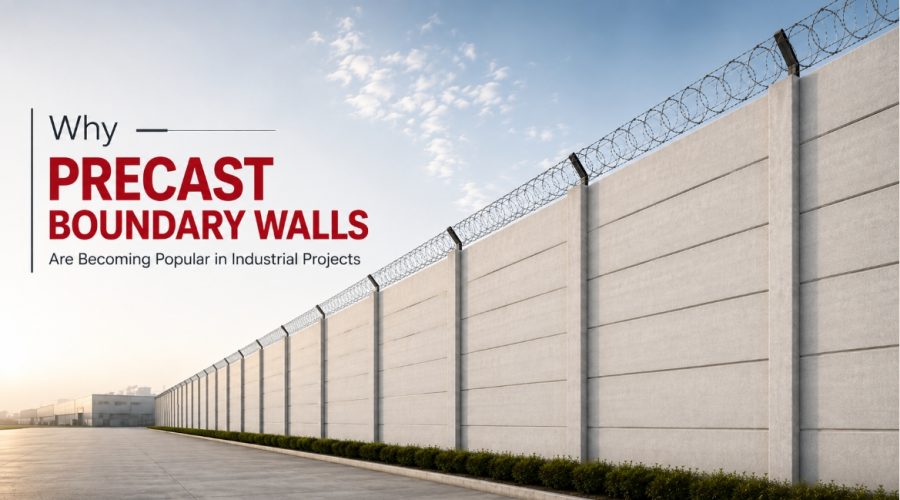
Why Precast Boundary Walls Are Becoming Popular in Industrial Projects
Precast boundary wall construction is changing how factories and industrial parks build their perimeters. A precast boundary wall is made from precast concrete panels and columns. Workers cast these parts in a factory, then bring them to the site for quick assembly. This is different from a brick wall, which is built piece by piece on site.
Industrial projects need strong, secure boundaries in a short time. A precast concrete boundary wall gives project owners speed, strength, and a lower total cost. Bashundhara Precast Boundary Wall, made by Bashundhara ReadyMix & Construction Industries Ltd. (BRMCIL) under Safwan Bashundhara Global (SBG), is built for this exact need. This blog covers what a precast boundary wall is, why industrial projects are choosing it, and how it compares to a traditional brick wall.
What Is a PC Boundary Wall?
A PC (precast) boundary wall, also called a precast concrete boundary wall, is built from hollow-core concrete wall panels and vertical ‘H’-shaped columns. Both parts are cast off-site using concrete extrusion technology. This method does not need wooden molds or formwork. Each panel is reinforced with high-strength carbon steel wire, which gives the wall its strength.
Because every panel is made in a factory under the same controlled conditions, each piece has the same size, strength, and finish. This is a key difference from a concrete boundary wall or RCC boundary wall that is cast on site, where quality can change from one section to the next.
| Specification | Standard Detail |
|---|---|
| Panel Width | 600 mm |
| Panel Thickness | 90 mm |
| Column Size | 280 mm × 180 mm |
| Wall Height Range | 4 feet to 10 feet (customizable) |
| Reinforcement | High-strength carbon steel wire |
| Production Method | Off-site concrete extrusion, no formwork or molds |
Why Precast Boundary Walls Are Becoming Popular in Industrial Projects
Industrial projects run on tight schedules and tight budgets. A prefabricated boundary wall fits both needs. Here are the main reasons factories, warehouses, and industrial parks are switching to precast walls.
- Faster construction timeline: Panels are cast in advance, so on-site work is mostly assembly. This cuts weeks off the schedule compared to building a wall brick by brick.
- Consistent, factory-controlled quality: Every panel comes from the same automated production line, so the wall looks and performs the same across the entire perimeter.
- Strength for an industrial security wall: High-strength steel wire reinforcement helps the wall handle daily wear at a factory or logistics site.
- Fire and sound resistance: The dense precast structure blocks noise and adds a layer of fire protection, which matters for factories near residential areas.
- Low maintenance: A precast wall resists cracking and does not need regular plaster repair, so upkeep costs stay low over the years.
- Eco-friendly production: Off-site casting produces less on-site waste and dust than traditional brickwork.
- Easy to extend: Modular panels make it simple to build a boundary wall for factory sites with long or irregular perimeters.
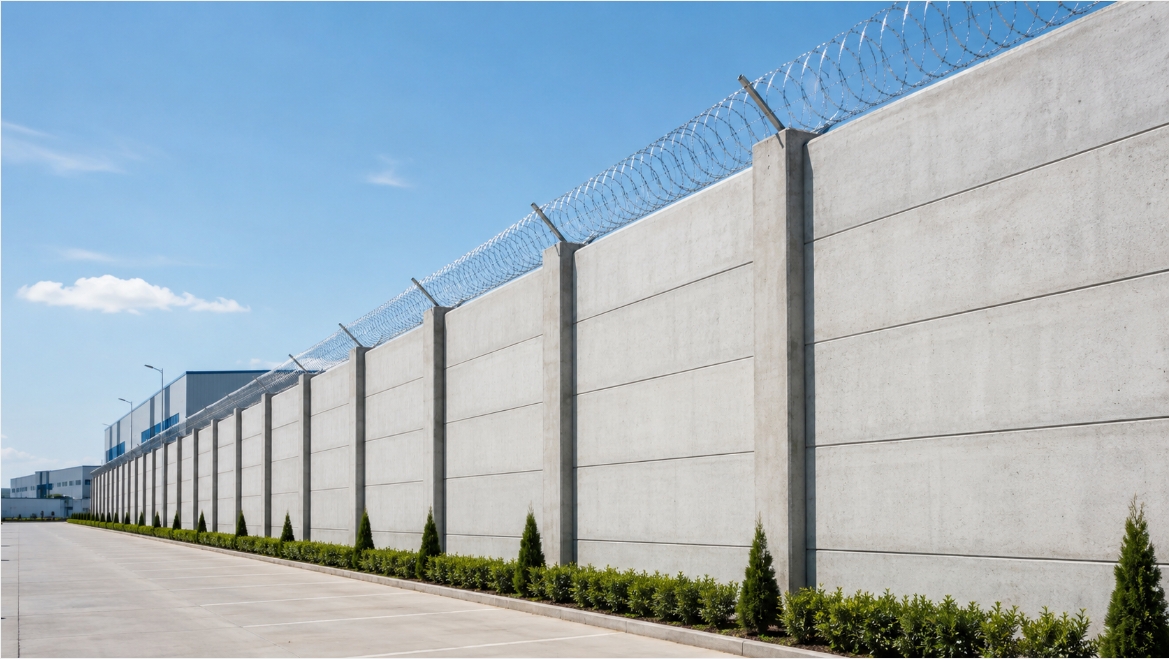
Precast Boundary Wall vs Brick Wall
The table below shows how a precast boundary wall compares with a traditional brick wall on the points that matter most for an industrial project.
| Feature | Precast Boundary Wall | Brick Wall |
|---|---|---|
| Construction Speed | Fast — panels are precast and simply assembled on site | Slow — built brick by brick on site |
| Quality Control | Factory-controlled, uniform panels every time | Depends on site labor, mortar mix, and weather |
| Weather Impact | Production continues off-site regardless of site weather | Rain and heat often delay curing and work |
| Maintenance | Low — dense concrete resists cracks and plaster damage | Higher — plaster, paint, and joints need regular upkeep |
| Reinforcement | Built-in high-strength steel wire in every panel | Reinforcement depends on manual site work |
| Best Fit | Large industrial perimeters, factories, mega projects | Small plots and short residential boundaries |
How Are Precast Boundary Walls Installed?
Installation is one of the biggest advantages of a precast boundary wall. Because the panels and columns arrive ready-made, the on-site process is short and simple.
- Site survey and layout: The team marks the wall line and checks the ground condition along the boundary.
- Foundation preparation: A footing or base is prepared at fixed spacing for each ‘H’ column.
- Column placement: Precast columns are set into the foundation to form the frame of the wall.
- Panel insertion: Hollow-core wall panels slide into the column slots, one panel above another, until the wall reaches the required height.
- Finishing: Joints are sealed, and the wall is ready for coating, paint, or texture work if needed.
Where Are Precast Concrete Walls Used?
A Precast Concrete Wall fits any project that needs a strong perimeter in a short time. Common uses include:
- Factories and manufacturing plants
- Industrial parks and economic zones
- Warehouses and logistics hubs
- Ready-mix and cement plants
- Institutional and commercial compounds
- Large residential projects that need a secure perimeter
Why Choose Bashundhara Precast Boundary Wall
Bashundhara Precast Wall is manufactured by Bashundhara ReadyMix & Construction Industries Ltd. (BRMCIL), part of Safwan Bashundhara Global (SBG). BRMCIL applies the same factory-controlled process used in its ready-mix concrete and PHC Pile production to its precast wall in Bangladesh line, so project owners get a wall built to a consistent standard.
- High strength: Reinforced with high-tensile steel for long-term durability.
- Cost-effective: Reduces material, labor, and time compared with a brick wall.
- Quick installation: The precast design shortens the overall project timeline.
- Premium quality: Automated, factory-controlled production keeps every panel consistent.
- Fire and sound resistant: Adds protection and noise reduction at the site boundary.
- Eco-friendly: Off-site production cuts material waste.
- Aesthetic appeal: Available in a range of textures and finishes for a modern look.
Project owners planning a factory Precast Concrete Wall or a large industrial perimeter can contact Bashundhara ReadyMix & Construction Industries Ltd. (BRMCIL) for a site assessment and quotation.
Frequently Asked Questions
What is a precast boundary wall?
A precast boundary wall is a boundary wall built from precast concrete panels and ‘H’ columns. Both parts are cast off-site in a factory and then assembled on the project site instead of being built brick by brick.
What is the difference between a precast boundary wall and a brick wall?
A precast boundary wall is cast in a factory and assembled on site, which makes it faster to build and more uniform in quality. A brick wall is built on site, brick by brick, which takes longer and depends more on site labor and weather.
Are precast concrete boundary walls suitable for factories?
Yes. A precast concrete boundary wall is well suited to factories because it is strong, fire and sound resistant, and needs very little maintenance. These qualities matter for sites that run continuous operations and cannot afford long construction delays.
Are precast boundary walls cost-effective for large projects?
A precast boundary wall reduces material waste, labor hours, and construction time compared with a brick wall. For large industrial perimeters, these savings add up across the full length of the boundary.
What is the price of a precast boundary wall?
The price of a Precast Concrete Wall depends on wall height, panel quantity, site condition, project location, and installation requirements. For an accurate quotation, it is best to share your project details directly with Bashundhara ReadyMix & Construction Industries Ltd. (BRMCIL) for a site-specific estimate.
Do precast boundary walls require maintenance?
A precast boundary wall needs very little maintenance. The dense, factory-cast concrete resists cracking and weather damage, so it does not need the regular plaster and paint repair that a brick wall often requires. A Precast Concrete Wall offers industrial projects a faster, stronger, and more practical alternative to traditional brick construction.
Its factory-controlled production and quick installation make it especially suitable for factories, warehouses, industrial parks, and large commercial sites.
For projects that require reliable perimeter protection, Bashundhara Precast Boundary Wall provides a durable solution designed for long-term performance.
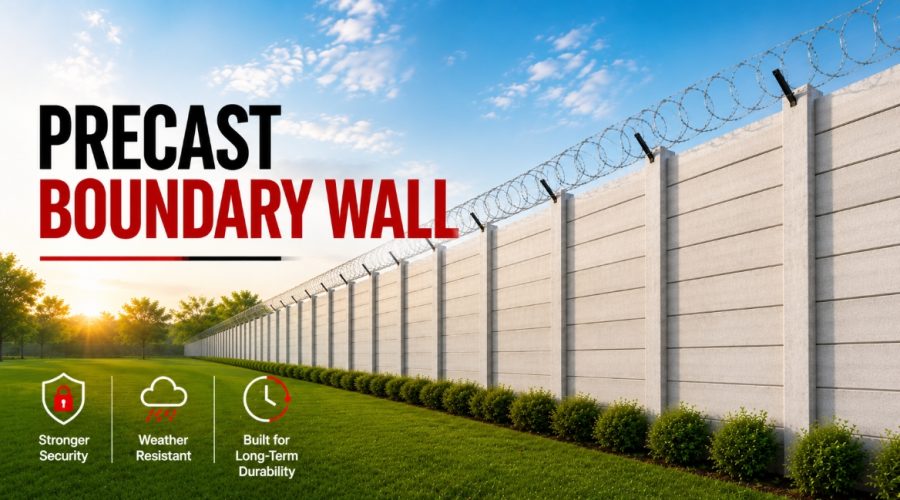
How Precast Boundary Walls Improve Security and Durability
A Precast Boundary Wall is a precast concrete wall built to protect the edge of a property. It gives strong perimeter security and lasts for many years with very little upkeep. Compared to a normal brick wall, it installs faster, resists weather better, and holds its strength for a longer time.
Boundary walls do more than mark a property line. They protect your land, your family, and your business from outside risks. But brick walls take weeks to build and often crack, lean, or grow weak over time. This is why more people across Bangladesh are now choosing a precast concrete boundary wall instead.
In this blog, we explain what a Precast Boundary Wall is, how it works, and why the Bashundhara Precast Boundary Wall is one of the best choices for property security today.
What Is a Precast Boundary Wall?
A Precast Boundary Wall is a type of prefabricated concrete boundary wall made from ready-built concrete panels. Instead of laying bricks one by one on-site, workers cast the wall panels in a factory first. Once the panels are ready, they are sent to the project site and put together like building blocks.
The finished structure works as a concrete boundary wall that stands as a single, connected system, not loose pieces stacked together.
This is a big shift from how walls were built in the past. A normal concrete wall for property protection could take weeks to build and dry. A precast wall skips most of that wait because the hardest part of the work already happens at the factory.
The Bashundhara Precast Boundary Wall uses hollow-core wall panels paired with ‘H’-shaped columns. These panels are made with advanced concrete extrusion technology, so no mold or wooden formwork is needed during production. Each panel also carries high-strength carbon steel wires inside it. This turns it into a true reinforced concrete wall, built to handle pressure, weather, and time.
How Bashundhara Precast Boundary Wall Is Made
The strength of any precast concrete construction starts with how it is made. Every Bashundhara wall panel is produced off-site, inside a factory where the process can be closely watched and controlled. This helps keep the mix, curing, and reinforcement placement consistent from one panel to the next.
Once the panels are ready, they travel to the project site. There, the ‘H’ columns act as a frame, and the panels slot into place between them. Because most of the hard work is already done, boundary wall installation on-site becomes fast, clean, and simple.
| Specification | Detail |
|---|---|
| Panel Width | 600 mm |
| Panel Thickness | 90 mm |
| Column Size | 280 mm × 180 mm |
| Wall Height | 4 feet to 10 feet (customizable) |
How Does a Boundary Wall Improve Security?
A strong boundary wall is the first line of defense for any property. It blocks easy access, stops trespassers, and gives a clear, visible line that separates your land from the outside. A well-built security boundary wall also adds a sense of privacy, which matters just as much for a family home as it does for a factory or warehouse.
The Bashundhara Precast Boundary Wall supports this in a few direct ways:
- Customizable Height: The wall can be built from 4 feet up to 10 feet, so you can choose a height that suits your perimeter security needs.
- High-Tensile Strength: The carbon steel reinforcement inside each panel makes the wall hard to break or push through.
- Uniform Build: Because every panel is factory-made, there are no weak joints or uneven sections, unlike a hand-built brick wall where quality can shift from one section to the next.
- Fire Resistance: The wall holds up well under heat, adding another layer of construction security for industrial or high-risk sites.
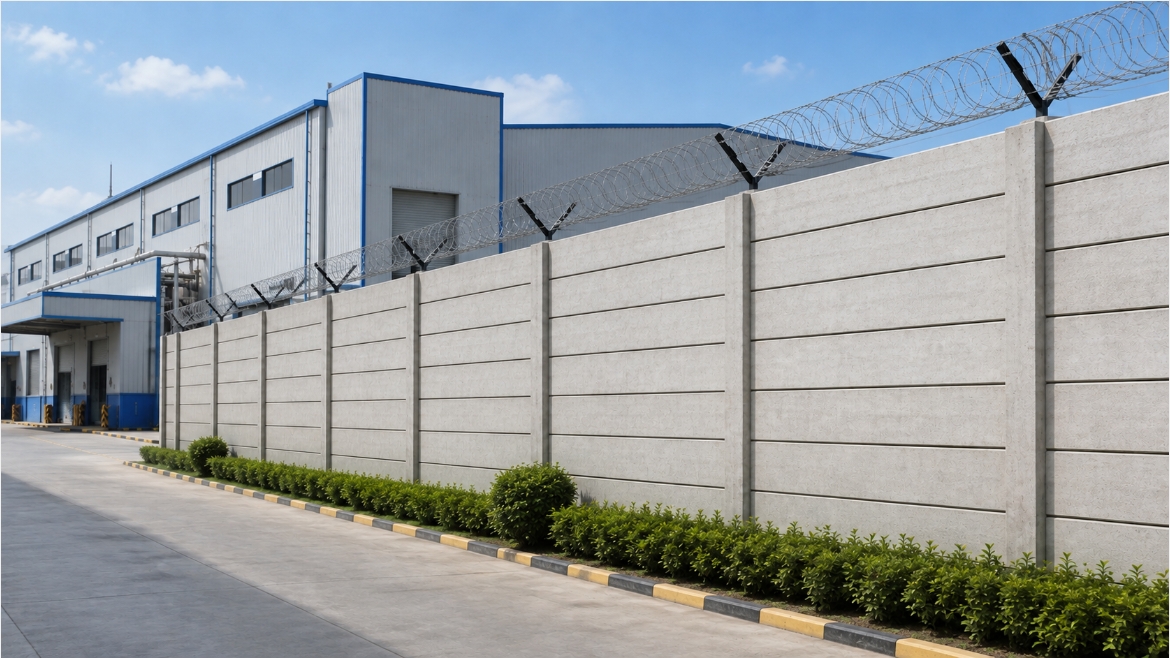
How Durable Is a Precast Concrete Boundary Wall?
Durability is one of the biggest reasons property owners choose a durable boundary wall over a brick one. The Bashundhara Precast Boundary Wall is built to handle years of daily wear without breaking down or needing constant repair.
- Weather Resistance: As a weather-resistant boundary wall, it holds up well through Bangladesh’s heavy rain, humidity, and heat.
- Low Maintenance: Once installed, this low-maintenance boundary wall needs very little upkeep compared to brick, which often needs replastering or repointing.
- Long Service Life: Built as a long-lasting boundary wall, it is designed to protect a property for many years without losing strength.
- Sound Resistance: The dense concrete panels also cut down outside noise, which helps for properties near busy roads.
So, how long does a precast boundary wall last? With correct installation, it can protect a property for many years while resisting weather damage and daily wear far better than a standard brick wall.
Precast Boundary Wall vs Brick Wall
Here is a quick side-by-side look at how the two options compare:
| Feature | Precast Boundary Wall | Brick Wall |
|---|---|---|
| Installation Time | Fast, panels assemble on-site | Slow, built layer by layer |
| Build Quality | Uniform, factory-controlled | Can vary by mason and site |
| Maintenance | Low, needs little upkeep | Higher, needs plastering and repair |
| Weather Resistance | Strong against rain and heat | Prone to cracks and damp |
| Overall Cost | Lower over time, less labor | Higher over time, more labor |
Where Can Bashundhara Precast Boundary Wall Be Used?
One strength of this system is how well it adapts to different types of property. Bashundhara Precast Boundary Wall works well as a:
- Residential boundary wall for homes and housing estates.
- Commercial boundary wall for offices, shops, and business parks, working as a low-maintenance boundary wall for commercial properties that stay busy year-round.
- Industrial boundary wall for factories, warehouses, and plants, giving a reliable boundary wall for factories and industrial sites.
- Perimeter wall for construction sites that need quick, dependable protection.
Whether it is a precast boundary wall for industrial property or a simple concrete fence around a family home, the same system adjusts to fit the need. This makes it one of the most flexible choices for property boundary protection in Bangladesh today.
Key Advantages of Bashundhara Precast Boundary Wall
So, what are the benefits of precast boundary walls? Here are the main advantages of precast concrete boundary walls that make Bashundhara Precast Boundary Wall stand out:
- High Strength: Reinforced with high-tensile steel for lasting durability.
- Cost-Effective: Uses less material, labor, and time than a brick wall.
- Quick Installation: The precast design means faster project completion.
- Premium Quality: Factory-controlled production keeps every panel consistent.
- Fire & Sound Resistant: Adds protection and cuts down outside noise.
- Eco-Friendly: Produces less waste and supports sustainable building.
- Aesthetic Appeal: Comes in different textures and finishes for a clean, modern look.
Why Choose Bashundhara Precast Boundary Wall?
Bashundhara Precast Boundary Wall is produced by Bashundhara ReadyMix & Construction Industries Ltd. (BRMCIL), a name trusted across Bangladesh for quality construction materials.
As one of the most reliable options for a precast concrete boundary wall in Bangladesh, it brings together strong engineering, factory-level quality control, and a fast, simple installation process.
Whether you are protecting a home, a business, or an industrial site, this wall offers a strong solution for property security without the long wait or ongoing repair costs of brick. For anyone searching for a dependable boundary wall in Bangladesh, it is a practical choice that puts strength and peace of mind right at the property line.
Frequently Asked Questions
Is a Precast Boundary Wall the same as a precast concrete wall?
A Precast Boundary Wall is a type of precast concrete wall specifically designed for property boundaries and perimeter protection. It is built using ready-made concrete panels that are cast off-site and assembled on location rather than built brick by brick.
How does a Precast Boundary Wall improve security?
It gives a strong, uniform barrier around a property. With customizable height, high-tensile steel reinforcement, and consistent factory-controlled construction, it is harder to break through than a standard brick wall.
How durable is a precast concrete boundary wall?
It is built to last for years with very little maintenance. The reinforced panels resist weather damage, cracking, and daily wear far better than traditional brick.
Is a Precast Boundary Wall better than a brick wall?
In many applications, a Precast Boundary Wall offers significant advantages. It installs faster, needs less maintenance, offers more uniform strength, and can reduce long-term costs associated with labor and repairs.
Are precast concrete walls suitable for Bangladesh’s weather?
Yes. The panels are built to handle heavy rain, high humidity, and strong heat, which makes them a good fit for the local climate.
How do I choose the right height for a boundary wall?
It depends on your property type and security needs. Homes often use a shorter wall for privacy, while factories or industrial sites may need a taller wall, up to 10 feet, for stronger protection.
Where can Bashundhara Precast Boundary Wall be used?
It works for residential homes, commercial spaces, industrial plants, factories, warehouses, and construction sites. The system adjusts to fit different property types and security needs.
Final Thoughts
A boundary wall is more than a line around your property. It is your first layer of protection. The Bashundhara Precast Boundary Wall brings together strength, speed, and long-term durability in one system, making it a smart choice for anyone building a home, business, or industrial site in Bangladesh.
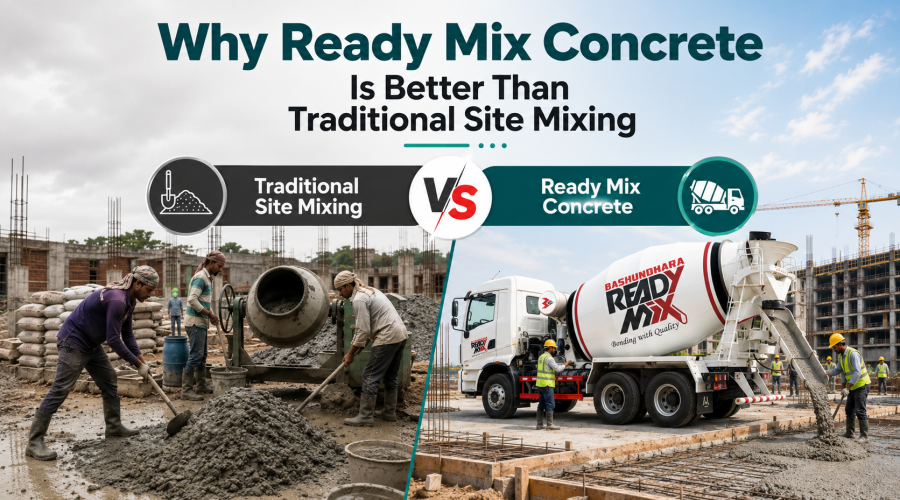
Why Ready Mix Concrete Is Better Than Traditional Site Mixing
Why Ready Mix Concrete Is Better is an important question for anyone planning a safe, durable, and cost-effective construction project. Unlike traditional site mixing, ready mix concrete is produced with accurately measured materials under controlled plant conditions. Understanding why ready mix concrete is better helps builders reduce human error, improve structural strength, and complete construction work faster
Think of a busy construction site in Dhaka. Workers are measuring sand, cement, and water by hand. Someone adds a little extra water because the mix looks too dry. The ratio is off — and nobody notices until the slab cracks three months later.
This is the everyday risk of traditional site mixing. It depends too much on human judgment. The ingredients change. The proportions change. And in the end, the construction quality suffers.
That is where ready mix concrete changes everything.
What Is Ready Mix Concrete?
Ready mix concrete, or RMC, is concrete that is mixed at a central batching plant, not on the construction site. The mix is prepared under strict quality controls, loaded into a concrete mixer truck, and delivered fresh to wherever it is needed.
Every batch follows the exact same formula. The water-to-cement ratio is measured precisely. The aggregates are weighed, not guessed. Nothing is left to chance. To understand why ready mix concrete is better for modern construction, explore our detailed guide on the benefits of ready mix concrete.
In Bangladesh, the demand for RMC Bangladesh is growing fast, and it is easy to see why.
Why Ready Mix Concrete Is Better
You can also learn more about concrete quality standards from a trusted engineering or construction authority to understand why ready mix concrete is better for structural applications. For project-specific requirements, read our guide on choosing the right concrete grade and discover why ready mix concrete is better for columns, beams, slabs, and foundations.
1. The Quality Is Consistent Every Single Time
With traditional concrete mixing on site, the quality can vary from batch to batch. One mix might be too wet. Another might be too dry. These small differences lead to weak spots in the structure.
Ready mix concrete removes that problem. It is produced in a controlled environment with calibrated machinery. Every batch meets the same standard. The result is durable concrete that you can count on.
2. It Saves a Lot of Time
On a traditional site, workers spend hours mixing, checking, and remixing. That slows everything down.
With RMC, the concrete arrives ready to pour. There is no waiting, no mixing, no back-and-forth. This means faster construction — which saves money and helps projects finish on schedule.
3. Less Waste, Less Cost
When workers mix concrete by hand, they often make more than needed or get the ratio wrong. Both situations lead to waste.
Ready mix concrete is ordered in exact quantities. You get what you need — nothing more, nothing less. That also reduces the cost of construction materials over time.
4. Stronger and More Reliable
Factory-controlled mixing gives durable concrete with higher and more consistent compressive strength. The mix design is tested and approved before production ever starts.
For structural elements like columns, beams, slabs, and foundations — this reliability is not optional. It is essential.
5. Better for Large Projects
Site mixing works for very small projects. But when you are building a multi-story apartment, a commercial complex, or an infrastructure project, the volume of concrete needed is enormous.
A concrete mixer truck can deliver large amounts of fresh concrete in one trip. Multiple trucks can be scheduled for continuous pouring. This kind of scale is simply not possible with manual site mixing.
6. Consistent Workability
One common issue with site-mixed concrete is that it dries out or becomes unworkable before it is fully poured. Workers then add extra water, which weakens the mix.
Ready mix concrete is designed to stay workable for the right amount of time. The slump value — which measures how easy it is to pour — is tested and maintained before the concrete mixer truck even leaves the plant.
The Real Risks of Traditional Site Mixing
Why Ready Mix Concrete Is Better becomes clear when you compare its consistent strength, faster application, and lower material waste with traditional site mixing. To be fair, site mixing has been used for decades in Bangladesh. It is familiar, and for small, low-load structures, it can still be acceptable. But the risks are real:
• Inconsistent mix ratio — changes with each batch
• Human error — measuring by eye is never accurate
• Slower work — mixing takes time away from actual construction
• Weaker concrete — poor control leads to reduced strength
• Weather impact — rain or heat can affect the mix before it sets
For any project where lives and loads are at stake, these risks are too high.
Why RMC Makes Sense in Bangladesh
Bangladesh is building fast. High-rise apartments, commercial towers, flyovers, metro infrastructure, construction quality has never mattered more. It gives builders greater control over construction quality while reducing delays, labor dependency, and costly mixing errors.
At the same time, skilled labor is expensive, and good supervisors are hard to find. Traditional site mixing puts too much pressure on the workforce to get it right every time. Why Ready Mix Concrete Is Better is that it eliminates guesswork and ensures every batch follows the correct mix design.
RMC Bangladesh solves this by moving quality control to the factory. The burden lifts off the site and rests with the engineers and technicians at the batching plant, where it belongs. Why Ready Mix Concrete Is Better is simple: it solves inconsistent mixing by using precise measurements and controlled production.
Bashundhara Readymix — Built for Bangladesh
When it comes to trusted ready mix concrete in Bangladesh, Bashundhara Readymix is a name that professionals rely on. For reliable performance from the first pour to the final set, Bashundhara Ready Mix Concrete offers a smarter and more dependable construction solution. Why Ready Mix Concrete Is Better becomes clear when builders need consistent quality, accurate mix ratios, and reliable structural strength.
With modern batching plants and strict quality standards, Bashundhara Readymix delivers consistent, high-strength concrete to construction sites across the country. Each batch is tested and certified, so builders can focus on their work without worrying about the mix.
Common Questions About Ready Mix Concrete
Is ready mix concrete expensive?
The upfront cost may seem higher than buying raw materials. But when you factor in labor savings, reduced waste, faster construction, and better structural quality, RMC often turns out to be more cost-effective overall.
Can ready mix concrete be used for small projects?
Yes. Ready mix concrete is available in different quantities. Suppliers can deliver smaller batches depending on the project size. It is not just for large buildings.
How long does ready mix concrete stay fresh?
Once loaded into a concrete mixer truck, the concrete stays workable for around 90 minutes. Delivery is scheduled to make sure it reaches the site well within this window.
Is RMC available across Bangladesh?
Yes. RMC Bangladesh availability has grown significantly in recent years. Major cities and industrial areas are well-served, with coverage expanding to new regions.
Final Words
Construction is not the place to cut corners. Every kilogram of concrete that goes into a building carries a responsibility to the people inside, to the neighbors around it, and to the years it is expected to stand.
Ready mix concrete gives builders the consistency, strength, and efficiency that traditional site mixing simply cannot match. It is not just a better product. It is a smarter way to build.
If you are working on a project in Bangladesh and want concrete that performs from the first pour to the final set, Bashundhara ready mix concrete is the answer.
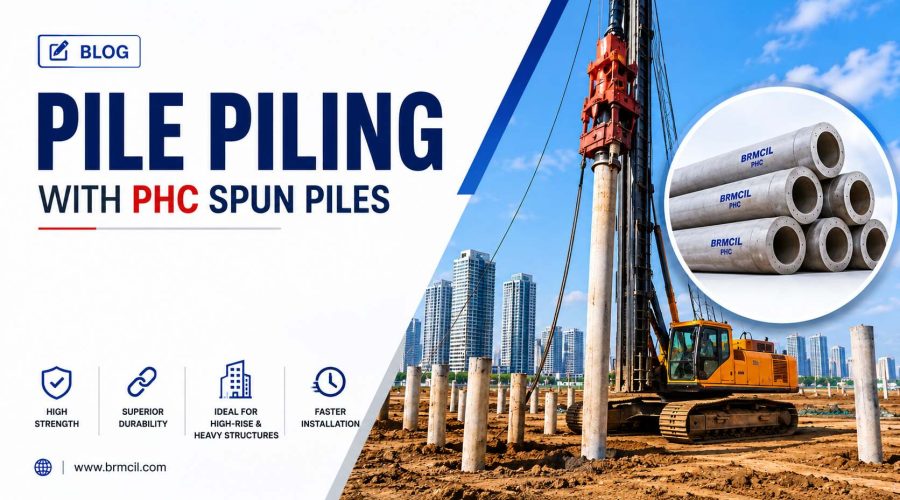
Pile Piling with PHC Spun Piles: A Reliable Foundation Solution
Pile Piling with PHC Spun Piles is one of the most effective foundation solutions for modern construction, delivering exceptional strength, durability, and long-term structural stability. Pile Piling creates the deep structural support needed for stronger, safer, and longer-lasting construction projects.
Every great building starts below the ground. Before walls go up or floors are laid, engineers must make sure the soil can carry the weight. That is where pile piling comes in. It is one of the most trusted methods in modern foundation engineering. And when you combine it with Bashundhara PHC Spun Piles, you get a foundation solution that is strong, durable, and built to last.
Understanding Pile Piling in Modern Construction
What Is Pile Piling?
Pile piling is the process of driving long, slender structural elements deep into the ground. These elements are called piles. They transfer the weight of a structure down to stronger soil or rock layers below. Think of it like inserting legs into soft ground so a heavy table does not sink. Pile piling does the same thing for buildings, bridges, and large structures.
In simple terms, a pile foundation means anchoring a structure to stable ground that lies far below the surface. It is one of the most reliable foundation solutions available in modern construction.
Why Pile Piling Is Essential for Strong Foundations
Not all soil is strong enough to hold a building on its own. Soft clay, loose sand, and waterlogged ground can shift or compress under heavy loads. This can cause a building to lean, crack, or collapse over time. From soft soil to heavy loads, pile piling provides the foundation strength modern infrastructure demands.
Pile piling solves this problem. It bypasses weak surface soil and transfers the load to stronger material below. This is why foundation piling is so important in areas with poor soil conditions. Bashundhara PHC Spun Piles are specifically designed to provide this kind of deep, reliable support.
When Is Pile Piling Required in Construction Projects?
Successful construction starts below the surface, where pile piling delivers unmatched foundation stability. It is not always needed. But in many situations, it is the only safe option. Engineers typically recommend pile piling when:
• The surface soil is too weak or too soft to support the structure
• The building load is very heavy, such as in high-rise or industrial construction
• The site is near water, like rivers, coastal areas, or wetlands
• Settlement or ground movement is a concern
• The foundation must resist horizontal forces, such as wind or earthquake loads
In Bangladesh, these conditions are very common. That is why deep foundation solutions like Bashundhara PHC Spun Piles are in high demand across the country.
Types of Pile Piling Used in Foundation Engineering
There are several types of piling used in construction. Each one works differently and suits different project needs. Understanding the piling methods available helps engineers choose the best approach for each site. Here is a quick overview. Pile Piling is the engineering solution that transforms challenging ground conditions into reliable foundations.
Driven Piles
Driven piles are pushed into the ground using a heavy hammer or hydraulic machine. They work by displacing soil as they go deeper. This type of pile is fast to install and works well in sandy or loose soil. However, it can cause noise and vibration during installation. Bashundhara PHC Spun Piles are a high-performance type of driven piles that overcome many of these limitations.
Bored Piles
Bored piles are made by drilling a hole in the ground and then filling it with concrete. They are useful in areas where vibration is a concern or where the soil is very hard. Among all piling methods, bored piles are slower to install but work well in dense ground conditions.
PHC Spun Piles
PHC Spun Piles are a type of driven piles made from prestressed high-strength concrete piles. They are factory-manufactured under strict quality control. The spinning process during manufacturing gives the concrete a very dense and uniform structure.
Bashundhara PHC Spun Piles are made using this advanced process. They offer exceptional strength and reliability for any foundation piling project.
Key Characteristics of PHC Spun Piles
• Made from prestressed high-strength concrete
• Hollow cylindrical shape for lighter weight and easier handling
• Manufactured in controlled factory conditions
• High compressive strength and load-bearing capacity
• Available in different diameters and lengths to suit project needs
Advantages Over Conventional Piles
Conventional concrete piles, including plain cast or timber piles, have limits. They can crack, rot, or corrode over time. Built for performance beneath the surface, pile piling ensures confidence in every structure above.
Bashundhara PHC Spun Piles overcomes these problems. They resist corrosion, last much longer, and deliver consistent strength. This makes them a superior choice among all types of concrete piles used in modern foundation engineering.
How PHC Spun Piles Improve Pile Piling Performance
High Load-Bearing Capacity
One of the biggest advantages of using Bashundhara PHC Spun Piles is their outstanding load-bearing capacity. These piles can carry very heavy vertical loads. This makes them ideal for high-rise buildings, bridges, and industrial structures where weight is a major concern.
The prestressed concrete design gives Bashundhara PHC Spun Piles a load-bearing capacity that standard piles simply cannot match. Engineers across Bangladesh choose them specifically for this reason.
Superior Durability and Structural Strength
Bashundhara PHC Spun Piles are manufactured using a centrifugal spinning process. This removes air bubbles and creates a very dense concrete structure. The result is a pile that is harder, stronger, and far more durable than traditionally cast concrete piles.
These piles do not crack easily under pressure. They maintain their structural strength even under the most demanding conditions. This is why they are the preferred choice in construction foundations across the country.
Resistance to Corrosion and Environmental Stress
Construction sites often expose materials to harsh conditions. Soil chemicals, groundwater, and humidity can all damage weaker piles over time.
Bashundhara PHC Spun Piles are highly resistant to these threats. The dense concrete structure acts as a natural barrier against moisture and chemical attack. This resistance is a key reason why they are trusted in critical construction foundations nationwide.
Performance in Coastal Areas
Coastal construction is one of the most challenging environments for any foundation. Saltwater, tidal movement, and soft marine soil put extreme stress on foundation systems.
Bashundhara PHC Spun Piles perform exceptionally well in coastal areas. Their corrosion resistance and high load-bearing capacity make them the preferred choice for ports, jetties, and waterfront developments.
Performance in Soft Soil Conditions
Bangladesh has large areas of soft, alluvial soil. Traditional construction foundations often struggle in these conditions. But Bashundhara PHC Spun Piles are designed to penetrate soft soil and reach stable load-bearing layers far below the surface. This ensures a secure and stable pile foundation even in the most challenging ground.
The Pile Piling Process: From Design to Installation
Successful pile piling does not happen by chance. It requires careful planning, expert foundation engineering, and precise execution. Here is how the process works when using Bashundhara PHC Spun Piles. By choosing Pile Piling with PHC Spun Piles, engineers and developers can ensure higher load-bearing capacity, faster installation, and reliable performance even in challenging soil conditions.
Site Investigation and Soil Analysis
Before any pile is installed, engineers study the ground. They conduct soil tests to understand the type, strength, and layering of soil at the site. This information helps them decide how deep the piles need to go and what load-bearing capacity they must carry.
Pile Design and Engineering
Based on the soil data, engineers design the pile foundation system. They calculate the number of piles needed, the required diameter, and the target depth. This step of foundation engineering ensures that the entire structure will rest safely and securely.
Manufacturing of PHC Spun Piles
Bashundhara PHC Spun Piles are manufactured in a modern facility using precise production methods. High-strength concrete is poured into steel molds and then spun at high speed. This spinning process creates a dense, uniform, and void-free concrete wall inside the pile.
Quality checks are performed at every stage of production. This ensures that every pile meets the required strength and dimensional standards before it leaves the factory.
Installation and Quality Control
Once the piles arrive at the site, installation begins. The process is monitored carefully to ensure each pile is driven to the correct depth and angle.
Transportation and Handling
Proper handling is important to avoid damage before pile installation. Bashundhara PHC Spun Piles are delivered with clear handling guidelines. Lifting points are marked, and trained crews manage the loading and unloading process to keep the piles in perfect condition.
Pile Driving Procedures
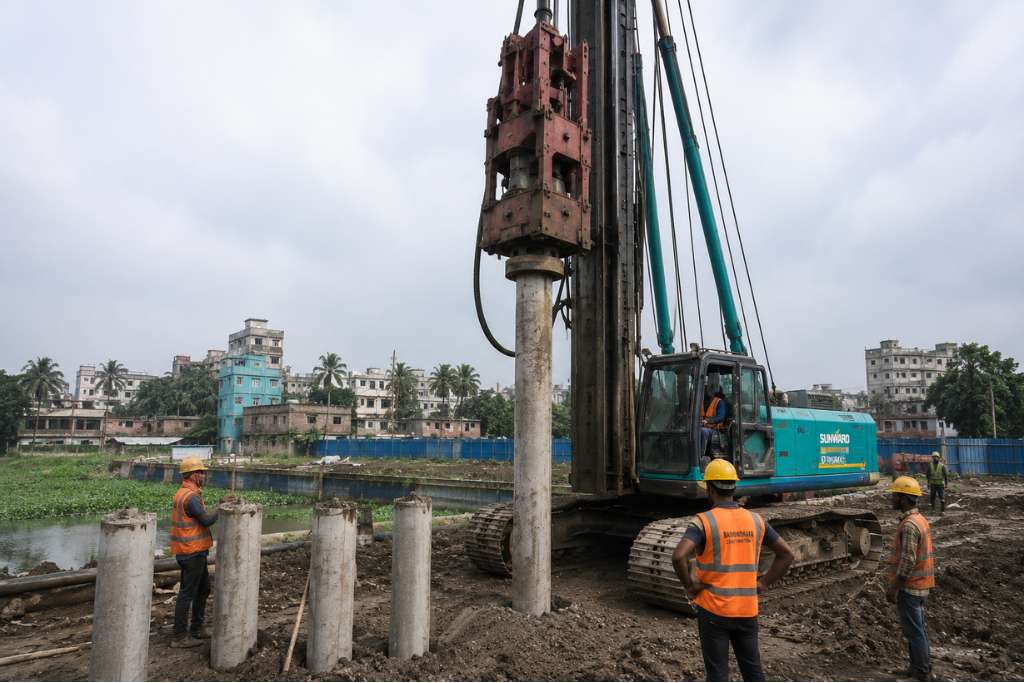
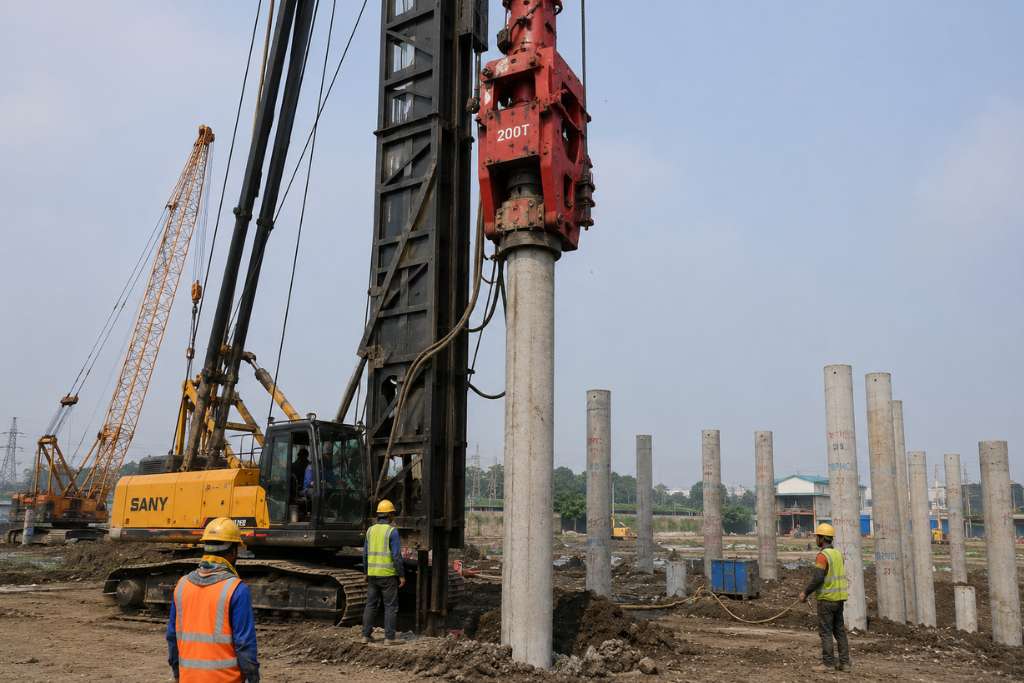
Pile installation is carried out using hydraulic or drop hammers. The piling rig drives each Bashundhara PHC Spun Pile into the ground with controlled force. Engineers monitor penetration rate and hammer blow count to confirm that the pile has reached the design depth and load-bearing capacity. This controlled pile installation process ensures every pile performs as designed.
Applications of Pile Piling with PHC Spun Piles
The versatility of Bashundhara PHC Spun Piles makes them suitable for a wide range of construction foundations. They are used wherever a deep, reliable foundation is needed.
High-Rise Buildings
Tall buildings place enormous loads on the ground. Standard shallow foundations cannot handle this pressure. Bashundhara PHC Spun Piles provide the deep foundation support that high-rise buildings need. They distribute the load evenly and prevent any settling or movement.
Industrial Facilities
Factories, warehouses, and processing plants require strong floors and stable ground support. These facilities often carry heavy machinery and large storage loads. Bashundhara PHC Spun Piles ensure that industrial structures remain stable and safe throughout their operational life. They are among the most reliable foundation solutions for industrial construction.
Bridges and Flyovers
Bridges and flyovers must carry the weight of vehicles, wind loads, and their own mass. They need foundations that go deep and hold firm. Bashundhara PHC Spun Piles are widely used in bridge foundation engineering because of their high load-bearing capacity and proven performance in all soil types.
Ports and Marine Structures
Ports, jetties, and marine terminals sit in or near water. The foundations must resist vertical loads, wave action, current forces, and saltwater corrosion. Bashundhara PHC Spun Piles are an ideal foundation solution for these environments. Their corrosion resistance and structural strength make them the top choice for marine construction foundations.
Commercial and Residential Developments
From shopping malls to apartment complexes, commercial and residential buildings rely on solid foundations. Bashundhara PHC Spun Piles are used in mixed-use developments across Bangladesh to provide reliable pile foundation support for all types of urban construction.
Infrastructure Projects
Large-scale infrastructure depends on strong, long-lasting construction foundations. Bashundhara PHC Spun Piles play a key role in major infrastructure development, offering proven foundation solutions across the country.
Transportation Networks
Roads, highways, and rail lines often pass over soft or unstable ground. Elevated sections and bridge supports require pile piling. Bashundhara PHC Spun Piles are used in these transportation projects to ensure safety and structural integrity for decades.
Energy and Utility Projects
Power plants, substations, and utility facilities require stable ground support. Foundation failure in these settings can have serious consequences. Bashundhara PHC Spun Piles provide the deep foundation reliability that energy and utility infrastructure demands.
Long-Term Foundation Reliability
One thing all these applications share is the need for long-term reliability. Bashundhara PHC Spun Piles are designed and manufactured to deliver just that. Once installed, they continue to support construction foundations reliably for many decades.
Benefits of Choosing PHC Spun Piles for Pile Piling
Faster Construction Timelines
Time is money in construction. Bashundhara PHC Spun Piles are factory-made and ready for immediate pile installation. There is no waiting for concrete to cure on-site. The process is also fast and efficient. This helps project teams meet tight deadlines and reduce overall construction time.
Reduced Maintenance Requirements
Once installed, Bashundhara PHC Spun Piles require little to no maintenance. Their dense concrete structure resists moisture, chemical attack, and biological deterioration. This means fewer repairs and lower long-term costs. It is one of the key benefits of choosing PHC Spun Piles over other piling methods.
Cost-Effective Foundation Solutions
While the upfront investment in quality piles may seem higher, the long-term savings are significant. Faster pile installation, fewer on-site problems, and minimal maintenance all add up to a very cost-effective foundation solution. Bashundhara PHC Spun Piles deliver excellent value for any project.
Consistent Factory-Controlled Quality
One of the biggest risks in construction is inconsistent material quality. Bashundhara PHC Spun Piles eliminate this risk. Every pile is manufactured under strict quality control in a factory environment. This means every pile meets the same high standard of strength and performance. This consistency is what separates quality concrete piles from ordinary ones.
Pile Piling vs Traditional Foundation Systems
Deep Foundations vs Shallow Foundations
Shallow foundations sit near the surface and work well when the ground is strong and stable. But when soil is weak, compressible, or waterlogged, shallow foundations are not safe. Deep foundation systems, like pile piling, bypass poor soil and reach stable layers far below. This is why deep foundation solutions are widely used in countries like Bangladesh where soft soil is common.
When to Choose Pile Piling
It is the right choice when:
• The soil near the surface cannot support the building load
• The structure is tall, heavy, or carries dynamic loads
• The site is in a flood-prone, coastal, or waterlogged area
• Long-term stability and minimal settlement are required
In all these cases, Bashundhara PHC Spun Piles provide a reliable and proven pile foundation solution. Among all piling methods available today, PHC Spun Piles is the most dependable option.
Factors Affecting Foundation Selection
Engineers consider many factors when choosing between piling methods and other foundation solutions. These include soil type and condition, building weight and height, site location, water table level, budget, and project timeline. Bashundhara PHC Spun Piles are flexible enough to be used across a wide range of these conditions.
Why PHC Spun Piles Are the Preferred Choice for Modern Construction
Engineering Precision
Bashundhara PHC Spun Piles are engineered with precision. From the mix design of the concrete to the tensioning of the prestressed steel strands, every detail is carefully controlled. This engineering precision is a core part of what makes them the best option in modern foundation engineering. No other foundation solution matches this level of factory-controlled accuracy.
Sustainability and Resource Efficiency
Modern construction must think about environmental impact. Bashundhara PHC Spun Piles use materials efficiently and last for a very long time. This reduces the need for replacement and lowers the overall environmental footprint of construction foundations. Choosing long-lasting concrete piles is one of the most practical ways to make construction more sustainable.
Long-Term Structural Performance
A foundation is not something you want to replace or repair. It must work perfectly for the entire life of the building. Bashundhara PHC Spun Piles are built for exactly that purpose. Their high load-bearing capacity, corrosion resistance, and structural durability ensure that the pile foundation keeps performing at full capacity for many decades.
Whether for high-rise buildings, bridges, ports, or industrial facilities, Pile Piling with PHC Spun Piles provides a dependable foundation solution built to support generations of development.
Frequently Asked Questions About Pile Piling
What Is the Difference Between a Pile and Piling?
A pile is a single structural element, such as a concrete column, that is driven into the ground. Piling refers to the overall process or system of installing these elements. When we talk about pile piling, we are talking about the complete activity of designing, manufacturing, and installing piles to create a deep foundation. Both terms relate to the same core concept in foundation engineering.
What Is the Standard Size of a Pile?
Pile sizes vary depending on the project requirements. Common diameters for PHC Spun Piles range from 300mm to 1000mm or more. The length can vary from a few meters to over 30 meters. Bashundhara PHC Spun Piles are available in various sizes to match the specific needs of different construction foundations.
What Are the Three Main Types of Piling?
The three main types of piling used in construction are:
• Driven piles, which are hammered or pushed into the ground
• Bored piles, which are formed by drilling and filling with concrete
• Sheet piles, which are used mainly for retaining walls and temporary excavation support
Among these types of piling, driven piles like Bashundhara PHC Spun Piles are the most common for large-scale projects. They offer the best balance of speed, strength, and long-term performance.
What Are the Four Types of Foundations?
The four main foundation types are:
• Shallow foundations such as strip, raft, and pad foundations
• Pile foundations that transfer loads to deeper soil or rock
• Caisson or drilled shaft foundations used for very heavy loads
• Combined foundations that use a mix of methods
Pile piling creates a pile foundation, which is the most reliable option for challenging ground conditions. It is also one of the most widely used foundation solutions in large-scale construction today.
How Long Do PHC Spun Piles Last?
Bashundhara PHC Spun Piles are built to last for 50 years or more under normal conditions. In some environments, properly installed PHC Spun Piles have performed reliably for much longer. Their resistance to corrosion and physical stress is a key reason for this outstanding durability. When you choose Bashundhara PHC Spun Piles, you are investing in a foundation solution that truly stands the test of time.
Why Are PHC Spun Piles Suitable for Large-Scale Projects?
Large-scale projects demand consistency, speed, and reliability. Bashundhara PHC Spun Piles deliver all three. They are factory-made to tight specifications, available in large quantities, and can be installed quickly at the job site. Among all piling methods available for large-scale work, pile piling with Bashundhara PHC Spun Piles is the most dependable choice. Their load-bearing capacity, durability, and consistent quality make them ideal for major infrastructure and construction projects.
Build Stronger Foundations with Reliable Pile Piling Solutions
Every structure tells a story. And that story begins underground. When the foundation is strong, the building stands firm through floods, heavy loads, and the test of time. When the foundation is weak, problems follow.
Bashundhara PHC Spun Piles give builders, engineers, and developers the confidence they need. These piles are not just construction materials. They are the backbone of safe, stable, and long-lasting construction foundations. Choosing Bashundhara PHC Spun Piles means choosing one of the most proven foundation solutions in the industry.
Whether you are working on a high-rise tower, a critical bridge, a port facility, or a large residential project, pile piling with Bashundhara PHC Spun Piles is a decision you can trust.
The Future of Foundation Construction with PHC Spun Piles
Bangladesh is growing fast. New cities are expanding. Infrastructure is being built at record speed. And as construction gets bigger and more complex, the demand for reliable, high-performance foundation piling will only increase.
Bashundhara PHC Spun Piles are ready for this future. With their advanced manufacturing, consistent quality, and proven track record, they represent the best in modern foundation piling technology. No other product in the market combines the load-bearing capacity, durability, and precision engineering that Bashundhara PHC Spun Piles provide.
When you choose Bashundhara PHC Spun Piles for your next project, you are not just choosing a product. You are choosing a deep foundation solution that will protect your investment and support your structure for generations to come.
Build with confidence. Built with Bashundhara PHC Spun Piles.

Best Spun Pile in Bangladesh
If you’re planning a construction project, choosing the right Spun Pile is essential for building a strong and durable foundation. Widely used in building foundations, bridges, industrial facilities, ports, jetties, and infrastructure projects, PHC Spun Pile offers superior strength, durability, and load-bearing capacity. As the demand for reliable foundation piles in Bangladesh continues to grow, Bashundhara PHC Spun Pile has become a trusted choice for engineers, contractors, and developers seeking high-quality prestressed concrete piles for long-lasting structural performance.
What is a PHC Spun Pile?
A PHC Pile is a type of foundation pile made from high-strength prestressed concrete. The name “spun” comes from the manufacturing process, the concrete is placed in a steel mold, and the mold is spun at high speed. This spinning forces the concrete to the outer wall of the mold, creating a hollow, cylindrical pile.
The result forms a concrete pile that is:
- Very dense and strong
- Resistant to cracking
- Uniform in shape and quality
- Able to handle high axial and lateral loads as a load bearing pile
PHC Pile and Spun Pile products are used all over the world because of their excellent performance and cost-effectiveness. And in Bangladesh, Bashundhara is leading this technology.
What is a Spun Pile Used For?
Spun Pile products are used in many types of construction. Here are some common applications:
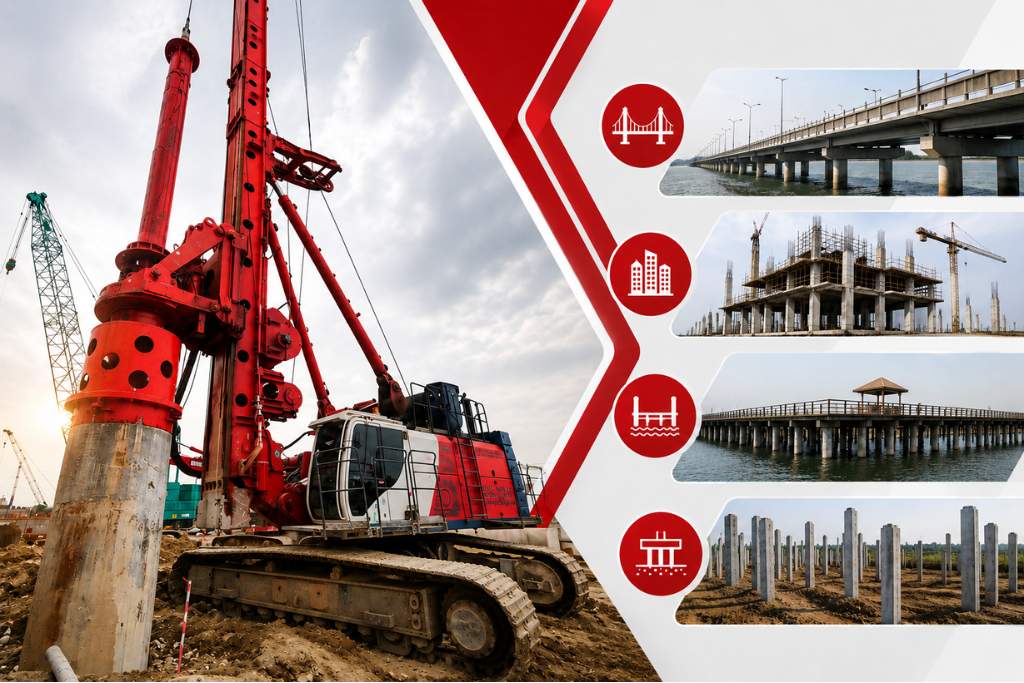
- Building Foundations: For high-rise buildings and large commercial structures, piling provides the deep structural foundation needed to support heavy loads.
- Bridges and Flyovers: Bridges need foundation support that can handle both vertical loads and horizontal forces. A strong load bearing pile is ideal for this.
- Industrial Plants and Factories: Heavy machinery and large storage facilities require a strong, stable foundation support. Concrete Pile solutions handle these loads with ease.
- Ports and Jetties: Marine structures face water, waves, and corrosive salt environments. The dense surface of a Prestressed Concrete Pile makes it highly resistant in such conditions.
- Power Plants and Energy Projects: Power plants and energy infrastructure need a deep, reliable structural foundation support. PHC Pile is a preferred choice for these critical projects.
- Roads and Infrastructure: Flyovers, underpasses, and road bridges all benefit from proper piling and foundation work.
Whether the ground is soft, waterlogged, or full of layers, a quality pile can reach deep, stable soil and transfer the load safely.
Best Spun Pile Manufacturer in Bangladesh
Bangladesh is growing fast. Every day, new buildings, bridges, and roads are being built across the country. But behind every strong structure, there is one thing that holds it all together, the foundation. And the foundation starts with the pile.
When builders and engineers look for the best Spun Pile solution in Bangladesh, one name keeps coming up: Bashundhara PHC Spun Pile.
From Dhaka to Chittagong, from small commercial buildings to large industrial projects — Bashundhara is the trusted concrete pile manufacturer and choice of engineers, contractors, and developers all over the country.
About Bashundhara Spun Pile
Bashundhara Group is one of the largest and most trusted business groups in Bangladesh. As a leading concrete pile manufacturer, Bashundhara PHC Spun Pile brings world-class quality to the local construction industry.
Their factory made concrete pile facility is built with modern technology. They follow strict quality standards at every step, from mixing the concrete to the final product. The result? A pile that is strong, durable, and reliable.
Bashundhara does not just make pile products. They make solutions. Whether it is a high-rise building or a heavy industrial facility, they have the right load bearing pile for every project. From high-rise buildings to bridges and industrial facilities, Spun Pile solutions provide the strength and stability needed for long-term structural performance.
Core Features of Bashundhara PHC Spun Pile
Here is what makes Bashundhara stand out from every other concrete pile manufacturer in Bangladesh:
- High Compressive Strength: The Prestressed Concrete Pile used in Bashundhara’s product has a compressive strength of 80 MPa or higher. This means the pile can handle extreme loads without cracking or failing — making it a true load bearing pile.
- Prestressed with High-Tensile Steel Wire: High-tensile steel wires are pre-tensioned inside each Prestressed Concrete Pile. This gives the pile extra strength and resistance to bending forces.
- Centrifugal Spinning Process: Each factory made concrete pile is produced using the centrifugal spinning method. This removes air bubbles and creates a very dense concrete pile structure, making it stronger and more durable.
- Hollow Core Design: The hollow core reduces the weight of the pile without reducing its strength. This also makes it easier to transport and handle on site during piling work.
- Smooth and Hard Surface: The outer surface of the PHC Pile is smooth and hard. This helps it resist corrosion, water, and soil chemicals — giving it a long service life as a structural foundation element.
- Available in Multiple Sizes: Bashundhara Spun Pile Bangladesh products come in various diameters and lengths. This makes them suitable for a wide range of piling and foundation projects.
- Consistent Quality: Every factory made concrete pile is produced under strict quality control. This ensures consistent strength and performance in every batch.
Who is the Manufacturer of Spun Pile in Bangladesh?
As the construction industry in Bangladesh grows, so does the demand for quality Concrete Pile and PHC Pile products. Among all the concrete pile manufacturer options in the country, Bashundhara PHC Spun Pile stands out as the most reputable and capable producer.
Bashundhara uses advanced European technology and international-standard raw materials to produce every factory made concrete pile. Their plant is designed for high-volume production without compromising on quality.
With experienced engineers and technical teams, Bashundhara ensures that every Prestressed Concrete Pile meets the required specifications — before it leaves the factory.
Best Spun Pile Supplier in Bangladesh
Having a good product is important. But being a reliable supplier is equally important.
Bashundhara PHC Spun Pile is not only the best concrete pile manufacturer — they are also the Best Spun Pile Supplier in Bangladesh.
Here is why:
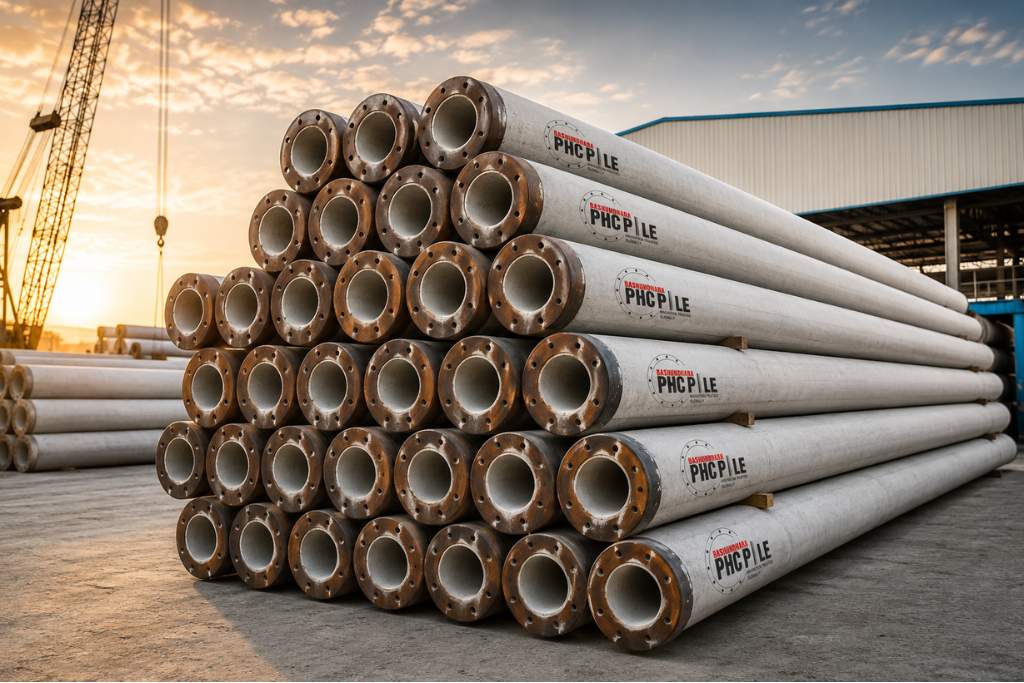
- Large Production Capacity — They can produce and deliver pile products in large quantities, meeting the demands of even the biggest piling projects.
- On-Time Delivery — Projects have tight schedules. Bashundhara understands this and delivers on time.
- Nationwide Availability — From Dhaka to Khulna, from Sylhet to Cox’s Bazar — Bashundhara can supply Spun Pile Bangladesh products across the country.
- Technical Support — Their team of engineers is ready to help with pile selection, load calculations, and piling installation guidance.
- Competitive Pricing — High quality does not have to mean high cost. As the Best Spun Pile Supplier in Bangladesh, Bashundhara offers fair prices without cutting corners.
Why Choose Bashundhara Spun Pile?
At the end of the day, the choice of structural foundation pile can decide the fate of your entire project. A weak pile means a weak building. And a weak building is a risk to people’s lives and your investment.
So why should you choose Bashundhara PHC Spun Pile?
Because it is trusted & tested. And because it is the best factory made concrete pile made right here in Bangladesh, with the quality standards of an international product.
- The Trust of Bashundhara Group: Bashundhara Group is a name that millions of Bangladeshis trust. Their Concrete Pile and PHC Pile products carry the same commitment to quality and reliability.
- World-Class Technology: The piling process, the materials, and the quality checks, everything follows international standards for Prestressed Concrete Pile production.
- Proven Performance: Bashundhara Spun Pile Bangladesh products have been used in major infrastructure and building projects across the country. The results speak for themselves as a reliable load bearing pile solution.
- Full Project Support: From planning to delivery to piling installation advice, Bashundhara supports you through every step of your foundation project.
- Long Service Life: Bashundhara PHC Pile is built to last. Its dense concrete pile structure, prestressed steel, and corrosion-resistant surface ensure decades of strong performance as a structural foundation.
When you build, you build for the future. Your foundation should be strong enough to carry that future.
Choose Bashundhara PHC Spun Pile, the Best Spun Pile Supplier in Bangladesh. For dependable piling solutions and superior foundation performance, trust Bashundhara PHC Spun Pile—the preferred choice for engineers, contractors, and developers building the future of Bangladesh.

Best Ready Mix Concrete in Bangladesh
Best Ready Mix Concrete solutions are essential for building durable infrastructure in Bangladesh’s rapidly growing construction sector. Choosing the right materials, especially high-performance concrete, is essential for any construction project. In Bangladesh’s rapidly growing construction industry, one material stands out for its reliability, quality, and efficiency ready-mix concrete (RMC). Many builders now prefer this because the quality of concrete is consistent, and the mixes are more durable.
If you’re planning to build, understanding your options is the first step toward success. This guide explains everything you need to know about the best ready mix concrete in Bangladesh, its benefits, grades, and leading suppliers. Among them, Bashundhara ReadyMix & Construction Industries Ltd., a concern of Safwan Bashundhara Global, stands out as the best ready mix concrete company for consistent quality and sustainable construction. It is also known as one of the leading providers of concrete in the country.
Why Choose Ready Mix Concrete?
In the debate of ready-mix concrete vs site mixed Bangladesh, the advantages are clear. While site mixing often results in inconsistency and waste, premium ready-mix concrete solutions like those from Bashundhara ReadyMix deliver superior strength and long-term durability.
Even other brands are used in the market, but Bashundhara remains No.1 due to its modern batching systems and reliable delivery.
Key Benefits of Best Ready Mix Concrete Bangladesh
1. Consistent Quality
Produced in a ready-mix concrete plant under controlled conditions, ready mix concrete Bangladesh ensures every batch meets specific quality standards. Bashundhara ReadyMix uses advanced technology, fully automated systems, and modern mixing plants to guarantee consistent strength and precise mix ratios. This includes maintaining proper mix design, specified mix design, and accurate psi measurements.
2. High Strength and Durability
As a high-strength ready mix concrete Bangladesh provider, Bashundhara ReadyMix offers grades like M20, M25, and M30. These grades ensure long-lasting, high-quality concrete solutions. They are suitable for residential, commercial, and large industrial projects. Bashundhara also supplies self-compacting mixes and durable mixes based on your project requirements. Best Ready Mix Concrete supports faster construction, reduced waste, and long-lasting structural strength.
3. Time and Cost Efficiency
With an affordable ready mix concrete Bangladesh pricing structure, Bashundhara ReadyMix reduces on-site labor and speeds up construction. It helps builders manage raw materials better and saves money through less waste and smoother workflow.
4. Reliable Delivery and Service
As a trusted ready-mix concrete supplier, Bashundhara ensures timely service with modern concrete mixer trucks. The supplier also provides transit systems to keep concrete fresh and ready for placement. Every batch is supported by engineers who guide the client on proper placement and how to cure the concrete for the best results.
Understanding Ready Mix Concrete Grades
Different grade levels of ready mix concrete are designed for specific uses. The ready mix concrete grade Bangladesh classification uses “M” followed by a number indicating strength.
| Grade | Strength (MPa) | Common Use |
| M20 | 20 MPa | Flooring, small houses, and walkways |
| M25 | 25 MPa | General building foundations and RCC structures |
| M30–M35 | 30–35 MPa | Industrial, bridge, and commercial use |
| M40+ | 40 MPa and above | High-rise and heavy-load infrastructure projects |
Bashundhara ReadyMix supplies a full range of ready-mix concrete solutions to meet national and global standards. These ensure precision, uniform quality, and long-lasting performance.
Finding the Right RMC Supplier in Bangladesh
Selecting the right supplier in Bangladesh is important for achieving strength and value in your project. Among all the readymix concrete suppliers in Bangladesh, Bashundhara ReadyMix has built a reputation for delivering high-quality ready-mix using modern batching systems.
What to Look for in a Ready Mix Concrete Supplier in Bangladesh
1. Quality Control and Certification
A reputable best ready mix concrete supplier maintains international quality standards. Bashundhara Readymix operates modern concrete plant facilities with a concrete laboratory to test aggregates, moisture, and compressive strength. This ensures consistent, best quality concrete output.
Bashundhara Readymix is proud to meet all major national and international quality standards, and the concrete has been tested and verified by BUET.
2. Production Capacity and Location
Strategically located concrete plants in Dhaka, Gazipur, and Narayanganj allow quick supply. A facility also operates near Narayangonj, Rupganj, and other key construction zones. This helps manage delays and maintains price stability. Best Ready Mix Concrete delivers superior performance with controlled mixing and advanced batching technology.
3. Delivery and Logistics
The best ready mix supplier in Bangladesh ensures smooth transportation. Bashundhara has a strong fleet of concrete mixer trucks, enabling timely delivery even in congested areas like.
4. Transparent Pricing
The best ready mix concrete price in Bangladesh depends on grade, quality, and location. Bashundhara offers clear pricing so clients can buy ready mix concrete confidently without hidden charges.
Ready Mix Concrete in Dhaka and Chittagong
The demand for the best ready-mix concrete providers is highest in Dhaka and Chittagong, the two pillars of Bangladesh’s development. These cities are embracing innovative concrete solutions for faster, cleaner, and eco-friendly materials used in construction.
Dhaka
Dhaka has become the hub of best ready mix concrete in Bangladesh, where modern construction depends on premium concrete solutions. Areas such as Uttara, Savar, and Keraniganj now have multiple ready-mix concrete plants operated by major suppliers.
Bashundhara ReadyMix ensures efficient supply from its facilities near Bashundhara Residential Area, Narayanganj, and Gazipur, maintaining reliable delivery to the capital’s biggest infrastructure projects.
From metro rails and expressways to residential and commercial towers, Dhaka’s builders rely on Bashundhara ReadyMix for quality concrete solutions for modern construction that save time and promote innovation and sustainability.
Chittagong
As Bangladesh’s main port and industrial zone, Chittagong is rapidly adopting ready-mix concrete for high-rise buildings, bridges, and port expansions. Areas such as Patenga, Sitakunda, Halishahar, Agrabad, and Pahartali now host modern concrete plants supplying premium ready-mix concrete across the region.
Bashundhara ReadyMix has built a strong distribution network throughout Chittagong, ensuring timely delivery to ongoing infrastructure projects and industrial developments. The city’s developers are increasingly choosing affordable ready mix concrete in Bangladesh to meet their construction needs efficiently.
Build a Stronger Future
The shift to the best ready mix concrete in Bangladesh is transforming the construction landscape. Bashundhara ReadyMix & Construction Industries Ltd. leads the way with construction solutions focused on sustainability, strength, and innovation. Backed by modern technology, a strong factory base, and expert teams, it continues to drive construction excellence.
So when choosing the right ready mix concrete, trust a manufacturer that delivers precision, performance, and long-term value. Bashundhara ReadyMix remains the top choice as Bangladesh continues to build its future with confidence. Best Ready Mix Concrete in Bangladesh ensures strength, consistency, and reliability for modern construction projects.
To ensure consistent quality, advanced batching, and reliable delivery, choose the Best Ready Mix Concrete from Bashundhara ReadyMix at https://www.brmcil.com/

Ready Mix Concrete Price in Bangladesh
Ready-mix concrete has completely changed the way construction works in Bangladesh. It’s fast, reliable, and consistently high-quality. This makes it a favorite across the ready mix concrete company in Bangladesh. But the big question is: how much does it actually cost? Understanding the ready mix concrete price in Bangladesh is essential if you’re planning for your next project. It also helps you choose the right ready mix concrete for durable and long-lasting results.
In this blog, we’ll walk you through the major factors that affect pricing. We’ll look at concrete grade, delivery charges, supplier pricing, raw materials, and labor. By the end, you’ll have a clear picture of the RMC price in Bangladesh. This will help you buy ready-mix concrete confidently and choose the most affordable option without any guesswork.
Factors Influencing the Ready Mix Concrete Price in Bangladesh
The ready-mix concrete per m³ rate in Bangladesh doesn’t stay the same. It depends on several variables that influence the final price. Understanding these factors can help you request a more accurate quotation for readymix concrete. Moreover, you can make informed decisions when choosing a readymix concrete company in Bangladesh.
1. Concrete Grade and Strength
The grade of concrete plays a big role in determining cost. Grade refers to the compressive strength (often measured in psi) achieved after 28 days. Stronger mixes require more cement and additives, increasing cost.
- M20 & M25 Concrete
M20 and M25 are among the most common choices for residential and commercial structures. The ready-mix concrete M20 and M25 prices in Bangladesh stay competitive due to high demand. These grades ensure durability while offering affordability, making them some of the best quality choices for everyday construction.
- High-Strength Concrete
For taller buildings, bridges, and heavy structures, high-strength grades such as M30+ are needed. Since these require more precision, a specified mix design, and careful quality control, the price of high-strength ready-mix concrete in Bangladesh is typically higher. Many modern projects also require high-performance or self-compacting mixes depending on structural needs.
2. Cost of Raw Materials
The cost of raw materials like cement, sand, stone chips, and water directly impacts the ready-mix concrete rate in Bangladesh. Market conditions, availability, and transport distance all influence material pricing.
Brands like Bashundhara, one of the leading cement producers and manufacturers of composite cement, often affect market rates. Since many batching plants source from major cement brand distributors, any price change affects the final concrete cost.
3. Delivery and Transportation Charges
Your site location is also important. The ready mix concrete delivery price in Bangladesh depends on:
- Distance from the concrete plant
- Fuel cost
- Site accessibility
- Traffic (especially in Dhaka, Uttara, and Narayangonj)
Because of heavy congestion and longer travel times in Dhaka, the ready mix concrete price in Dhaka may be slightly higher. Suppliers with concrete mixer trucks, strong logistics, and reliable delivery systems maintain better consistency.
4. Concrete Pump and Labor Cost
Many construction sites, especially high-rise projects, require concrete pumps. The price of a ready-mix concrete pump in Bangladesh is typically charged per hour or per cubic meter pumped through transit systems.
Despite the convenience of ready-mix, you still need skilled workers to pour, level, and cure the concrete aggregate. So the ready-mix concrete labour & material cost in Bangladesh remains an important part of your project planning.
Typical Range for Ready Mix Concrete Price in Bangladesh
Sharing an exact ready-mix concrete price list isn’t possible because prices vary by region, supplier quality, and grade. However:
- Standard Grades (M20/M25): Competitively priced
- Higher Grades: Cost increases with strength requirements and precise mix design
Remember that pricing depends on material quality, batching technology, and the performance of the ready mix concrete company you choose.
Benefits of Using Ready Mix Concrete Price
Ready-mix concrete is popular because it offers:
- Consistent Quality: Thanks to fully automated and modern mixing plants
- Faster Construction: Reduces on-site mixing
- Less Waste: Exact batching
- Reduced Labor: Less manual mixing
- Durable mixes: Strong long-term performance
- Sustainable and structured production
Using premium ready-mix concrete helps ensure lasting construction excellence and superior quality of concrete.
Tips for Choosing the Best Ready-Mix Supplier
Choosing the right ready-mix concrete supplier has a huge impact on pricing, durability, and quality. Here’s what to look for:
Reputation & Quality Control
Choose suppliers known for high standards. For example, Bashundhara ReadyMix & Construction Industries Ltd. is one of the leading suppliers in the country. Bashundhara uses advanced technology, a modern laboratory, and automated batching to ensure strong mixes. This makes them one of the leading choices for reliable and high-quality ready-mix.
Fleet Size & Delivery Reliability
Suppliers with their own fleet of concrete mixer trucks can deliver faster and more efficiently. This directly affects the ready mix concrete price in Dhaka, especially in busy areas like Uttara, Rupganj, and Narayanganj.
Availability of Pumping Services
Choosing a supplier that offers pump rental ensures a fair ready mix concrete pump price in Bangladesh and faster placement on site. This also reduces overall labor costs and ensures precise pouring.
Transparent Pricing
Always request a detailed ready mix concrete quotation in Bangladesh, including grade, pump cost, transport, and labor.
Customer Support
A professional supplier in Bangladesh helps their client select the correct grade, determine volume, and choose the right ready mix concrete based on the project’s structural needs.
These steps will help you choose trustworthy ready mix concrete suppliers or mix concrete suppliers in Bangladesh who provide valuable and durable construction solutions.
The ready-mix concrete cost in Bangladesh depends on grade, materials, transport, pump usage, and labor. While the cost of ready-mix concrete per cubic metre in Bangladesh may vary, ready-mix remains an essential part of modern infrastructure due to its durability, speed, and consistency.
By understanding the market and comparing the ready mix concrete price with other regions, you can make better decisions. This helps you choose a concrete company in Bangladesh, a manufacturer, or a ready mix concrete plant that matches your needs. You may want to buy ready mix concrete for small projects, or you may need a range of ready-mix concrete solutions for larger builds. Selecting a dependable team ensures construction excellence, sustainability, and long-term results.